Gia-Linh Dang
The Criminally True Truth of the True Crime Community
One of the internets biggest community in pop-culture. The True Crime community dabbles in the world’s most haunting stories. But what about the stories that make the community itself? The researchers, the authors, the influencers, the community.
Gia-Linh Dang
"Lit"eracy
Community literacy refers to how much an individual knows about a certain community. Being literate in a topic means you know much about it, it’s the same as a community! Literacy can be described as many things, from understanding topics within the community that may stump the normal person, to being able to recite the name of every company, name, or place within the topic.In True Crime, being literate in the community means to understand how the community works. How do the people act? What do they like to do? What else is there to know?
Being literate may mean you also understand videos and podcasts on a deeper meaning!
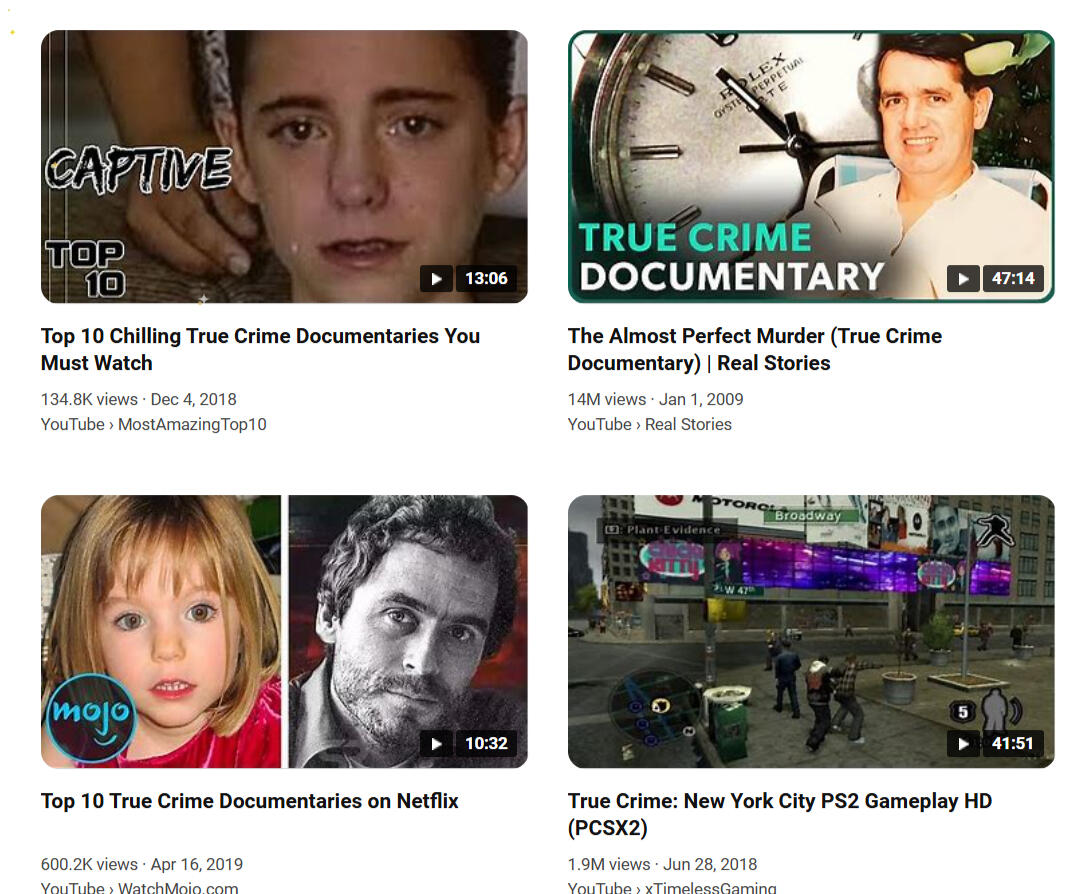
Who are they?
“Deep Dive”
DIVE DEEP!
The True Crime Community is a community that specializes in the aspect of crime activity in the real world. While typical people deem crime and murder as morbid and violent, the True Crime Community specializes in researching those topics and discussing them amongst one another. Their unique understanding of criminal activities and literacy in all things crime related is a complex concept to many others who are not a part of the community, but despite backlash on those who see this type of practice immoral and dangerous the True Crime Community continues to thrive. This study focused on “deep diving” into the “case files” of this organization, researching the reasons of which the community became interested in this topic, their goals and motivations, and thoughts on being in the community in general.
ETHICS... METHODS?
Conducting research on this specific community was a difficult task, as the True Crime community resides mostly online and has little relevant information due to how broad the overall community is. However, the information was easy to obtain via documents online and studies that were published prior to this research. As a researcher, I focused on obtaining information mostly with secondary outside sources like articles and documents alongside the silent observation of public online spaces. Alongside that, I meticulously picked out articles that seemed to have a high reading of people within the community themselves. The interviews conducted were focused on the feelings of the person themselves and their own personal feelings or experiences within the community. My studies consisted of observing online spaces that hold a significant amount of active members within the community, interviewing individuals who are familiar with or are a part of the community so I would be able to see both sides and how they portray the community. I researched different literacy artifacts, literacy events and even listened to some true crime myself to understand the appeal of true crime.
Research: The True Research of True Crime
The Grouped Reasearch
Despite being a collective community, the True Crime Community consists of multiple subgroups that seem to specialize in their separate activities. From content creators to true crime investigators to listeners, the community has a wide span of different groups that co-exist with the community of true crime in general. Though they are separate groups they still join together to create the community as a whole. Members of the community don’t just stay in their groups, they seem to communicate equally with each other. When observing the groups as a whole within online spaces such as, “Reddit” “Discord” “X (formally known as Twitter)” “YouTube” and many others, the members seem to always be in one or more subgroups of the community, and sometimes a mix of all of them depending on the subject at hand.
The discussions I observed consisted of different sessions on different subjects ranging from overall observation of recent true crimes to attempting to solve unsolved crimes from the past. A Discord community I observed called this “research switching”, which means that they switch their attention to a different subject at different scheduled times. Different groups seemed to have different literacy artifacts alongside them, for an obvious example a podcaster would use a microphone to record their videos and conversations, while someone who would rather stay low and research on their own would prioritize research files and the physical artifacts within the actual crime scene, though they share the same common artifact of the internet in general as it’s almost impossible to catch up with new information without the help of the news and internet constantly broadcasting information online at all times. The True Crime community, despite being relatively online, consists of numerous real-life places and events for different groups, strengthening literacy within their community. These events consist of Crimecon, CrimeHQ, and many other minor groups. Overall, the community seems very connected with each other despite being in different groups in general.
Community Gatherings
Social Hangouts
As stated, the True Crime community resides mostly online, a few linked websites are listed that dabble in the True Crime world!
Community Truth!
The Real "Truth"
Outsiders of the community portray the True Crime Community as gruesome and inhuman as they think using criminals and victims as entertainment is absolutely unacceptable. The community has been described as many different words, " Journalists described the genre as “salacious,” “tawdry,” “lowbrow,” “grisly,” andas having “prurient appeal.”" (Sherril 1484)True Crime community doesn’t view what they do as entertainment, when interviewed, many of them commented that they even agree with the statement of such acts being unacceptable. "I think people who see it as "fun" shouldn't be apart of the community" Baneen, an intervewee had stated.
The True Crime community primarily uses videos and research to bring awareness to what happened to the victim, bringing in information and numerous amounts of recourse for what had happened to them. Many Reddit pages specifying boundries to keep a serious tone " including ‘Don’t Glorify Criminals or Violence’; ‘No memes’ and ‘No sensationalist titles’"(Fathalla 6)A popular True Crime podcast site states : "We embrace a platform where curiosity meets compassion....the pursuit of justice is the highest calling." Similarly, they state "We provide authentic narratives that illuminate the complexities of criminal behavior while honoring the victims and their families." (Societal Crime Club)
They use this information to help others understand what is wrong and how criminal activity could affect others who are not even inside the victims overall circle. The community could even heavily benefit in ways we don’t expect. For example, there was an unsolved case of a woman who was killed years ago, who was never brought to peace due to her identity and killer being unknown. The woman was known as “tent girl” due to her being wrapped with a tent tarp, but she was never identified. Years later, a member who was considered within the True Crime community within a group that included investigations of unknown cases brought justice to the woman’s family by spending years investigating her identity and finding her family and name. This information was provided by a Youtube channel by the name of "Brew"This shows that the True Crime Community isn’t how others outside the community portrays them, but instead are individuals who just want to raise awareness and assist others. "I guess the only thing I would want people to know is that we are not crazy people looking for ways to get rid of someone." An interviewee by the name of Roselin responded.
Community Truth!
The Start of the Beginning
There was no particular reason most of these members joined the True Crime Community nor why they were drawn to the community in the first place, a common thought that most of my interviewers had when answering the specific question of how they got into the community was YouTube videos. "I just stumbled upon a Rotten Mango video and her way of story telling enticed me and got me to stay, which led me to become interested in true crime" An interviewee, Eileen, commended, "Iv been in the community for 2 years now."This was surprising to me as I was under the impression that audio recorded podcasting was the most popular way of achieving information on true crime and influencing children. This is due to the fact that podcasts have been more popular and accessible lately and with true crime podcasts came the stereotype of the “True Crime Podcast girl” which shines a bad light on women within the community. Most others who are not a part of the community stereotype certain people into being into True Crime, the most popular being young women. However, when researching information about this community I came across a plethora of different people who were a part of the organization who I would’ve never thought of being a part of . Generally, most of the individuals who I studied while doing my field notes consisted of young men who were interested in the topic. It was a surprising finding since most of my interviewers consisted of women. When you think of true crime some people may think edgy, gothic characters who spoke about true crime on numerous occasions, but the individuals I had met personally had no hint on how they were in the overall community despite the questions being about the community in general. One of my interviewees seemed to even be in professional attire and looked like was about to go to work or a very professional area, this shows how all ages and genders could be a part of the community. Meanwhile, outside the community individuals see to true people within the True Crime community, I asked multiple interviewees to answer the question of how they feel about the attention their community is getting due to the True Crime Community receiving backlash because of other’s different goals, however the interviewees seemed to not notice nor care about how others portray them as long as they are able to continue what they’re doing.
Despite the speculations amongst others who see them as inhuman and “messed up” due to their interests. This revealed that the community itself doesn’t seem to pay attention to what others think of their community, which shows the strength and passion the people of the organization have to continue to research within the True Crime Community. A member of the community by the name of Raya stated “I’ve never really heard any negative comments about the community but it wouldn’t really bother me."CONCLUSION!
The True Crime Community had a very minor amount of information about the, despite being mostly consisting online, some of the information were mere speculations and stereotypical rumors about the community. The community recently has been a part of a recent controversy regarding its ethicality and how “only women watch true crime.” Due to these allegations, it is important to shine light on one of the most popular but also misunderstood
SourcesBoling, Kelli S., and Kevin Hull. “Undisclosed Information-Serial Is My Favorite Murder: Examining Motivations in the True Crime Podcast Audience.” Journal of Radio & Audio Media, vol. 25, no. 1, 2018, pp. 92–108, https://doi.org/10.1080/19376529.2017.1370714.Fathallah, Judith. “‘BEING A FANGIRL OF A SERIAL KILLER IS NOT OK’: Gatekeeping Reddit’s True Crime Community.” New Media & Society, vol. 26, no. 10, 2024, pp. 5638–5657, https://doi.org/10.1177/14614448221138768.Scott, Russ, et al. “‘True crime’ stories and psychiatrists’ ethical responsibilities.” Australasian Psychiatry : Bulletin of the Royal Australian and New Zealand College of Psychiatrists, vol. 29, no. 4, 2021, pp. 396–401, https://doi.org/10.1177/1039856220970046.societal crime club - Bing. Bing. https://www.bing.com/search?q=societal+crime+club&cvid=73af9979e78540e2a3bfa53eabf12ac8&gs_lcrp=EgRlZGdlKgYIABBFGDkyBggAEEUYOdIBCDMzMzdqMGoxqAIAsAIA&FORM=ANAB01&PC=LCTS.Sherrill, Lindsey A. “The ‘Serial Effect’ and the True Crime Podcast Ecosystem.” Journalism Practice, vol. 16, no. 7, Dec. 2020, pp. 1–22, https://doi.org/10.1080/17512786.2020.1852884.